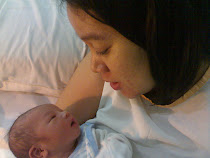
Parenting 101: To smack or not to smack.
Labels: Mommy Talk, Parenting
Latching on and Unlatching
To get him open his/her mouth, lightly stroke your nipple across his/her lip. When his/her mouth opens really wide, quickly bring your baby onto the breast -- don't try to bring the nipple to him/her or he/she won't take enough in and you'll be uncomfortably bent over. His/her mouth should close around as much of the areola as possible and his lips should be turned out, not tucked in. You may feel some discomfort at first, but it should ease after Baby begins a deep, rhythmic sucking and pausing pattern.
Signs that your baby is not latched on correctly include
- hearing clicking noises instead of swallowing
- continuing to feel pain while he feeds
- feeling like he's pulling on the nipple
- having her/him fall off the breast again and again
Allow Baby to nurse about 10 minutes on the first breast, then switch to the other side and let him/her continue until he's done -- you'll probably notice the sucking slowing down or ceasing altogether. Sometimes Baby will just drop off the breast himself. Other times you may have to break the suction or "unlatch" him/her. Never try to just pull your baby off. Instead, slide your little finger into the corner of his/her mouth, press down on the breast, then remove him/her from the nipple. The next time you feed your baby, start with the breast you didn't start with this time, since the breast you use first gets better drained. If you have trouble remembering which goes next, attach a safety pin to your bra.
During the first few days after birth, your breasts will produce a substance called colostrum, a thick, rich, yellowish forerunner to mature milk. On the third or fourth day, your milk will come in, so nurse frequently for the next 24 to 48 hours to reduce the chance of engorgement, an uncomfortably full, tender, swollen sensation. From this point on your breasts will feel full every few hours for feedings, according to the routine you and Baby are on. At first that may mean beginning a feeding as often as every two hours around the clock, gradually spreading out to every three or four hours.
One of the things new moms are most paranoid about is whether or not Baby is getting enough to eat. You'll know she's/he's doing fine if she's/he's feeding frequently, latches on well, and sucks vigorously; if she/he wets six to eight diapers a day and has several yellow bowel movements a day; and if she's/hes gaining weight at a consistent rate. Don't be afraid to call the doctor immediately if you have nay doubts or concerns; nursing problems are easier to remedy if caught early. Your doctor may be able to help you and can refer you to a lactation consultant if necessary. Don't wait until problems are extreme: The most obvious sing of severe dehydration is a sunken soft spot on top of Baby's head. Other symptoms: sunken eyes, excessive drowsiness, and decreased urination.
Labels: Mommy Talk
The Breastfeeding Techniques
- Cradle Hold - While sitting upright, cradle the baby's head in the crook of your arm on the side you want to nurse from. Her/his body should be lying across your lap and facing toward your chest. Cup your breast outside the areola (the darker area around the nipple) with your other hand, and use your arm to pull your baby toward you.
- Cross-Cradle Hold - The arms are switched in this variation on the previous position. The baby is supported by the arm and hand of the side opposite from the breast being used, so that you can put your hand behind her/his head for extra control. This position is ideal for small babies, or those who have trouble latching on.
- Football Hold - Tuck Baby's legs underneath your arm so that they're behind you with him/her looking up at your nipple. Hold your breast with the hand opposite the side you're nursing on. Position the nursing-side hand behind Baby's head, and pull him onto the breast. This position is especially good if you've had a c-section, because it avoids putting pressure on your abdomen. It also gives you good control over your baby's head during latch on.
- Lying Down - Many seasoned breastfeeders love this position because they barely have to wake up for night nursings. Lying on your side with your head in the crook of your arm, tummy to tummy, and her/his mouth pointed toward your nipple. It's essentially a lying-down version of the cradle hold.
Labels: Mommy Talk
Why Breastfeed?
Breastfeeding also confers some important health benefits on mothers:
- It will help shrink your uterus back to its normal size
- use up fat stores accumulated during pregnancy, which contributes to postpartum weight loss
- suppress your menstrual periods, which helps to replenish iron stores lost during pregnancy and childbirth
- and even confers some protection against more serious illness like osteoporosis, hip fracture, and breast and ovarian cancer. Not to mention that all-important emotional connection fostered by the intimate contact involved in breastfeeding.
Labels: Mommy Talk
Breastfeeding
Of course, plenty of mother find breastfeeding to be the easiest thing in the world. But others consider quitting before they've given themselves and their babies chance to get good at it. This special section is designed to help you hang in there -- both yo and Baby will be glad you did.
Why Breastfeed?
Because it's worth it. The American Academy of Pediatrics is so gung-ho on the health benefits of breastfeeding that they recommend mothers nurse their infants for the entire first year of life, if not longer. Human milk contains the ideal proportions of more than two hundred ingredients -- including protein, fat, carbohydrates, vitamins, minerals, enzymes, and antibodies -- that aren't duplicated in any formula...read more
The Techniques
Just like any other skill, proper technique is important to successful breastfeeding. Getting it right makes all the difference in your comfort level and your baby's being adequately nourished. Here are the basics for beginners -- they may seem challenging at first, but a month into the process, you probably won't even have to think about them...read more
Latching on and Unlatching
One of the most challenging aspects for novice breastfeeeders is getting Baby onto the breast correctly. He's/She's born with a rooting reflex that makes him/her turn toward the breast and open his mouth, and a sucking reflex that's activated when the nipple touches the roof of his/her mouth. But none of this matters if he/she doesn't grasp the breast correctly...read more
Labels: Breastfeeding, Mommy Talk
Parenting Vocabulary
cord care - The shriveled brown appendage that was once your baby's umbilical cord requires only a quick swipe with rubbing alcohol each time you change her/his diaper. Fold the diaper down around it to keep the area dry. In about a week you'll find a perfect little belly button instead. Trouble signs to watch for: redness and pus -- but a little bleeding when the cord falls off is normal.
burping - What was once bad manners is now a must in your home. Babies take in air while they're sucking on the breast or bottle, and they need some help releasing it or they become cranky and uncomfortable (a.k.a. "gassy"). To avoid this buildup, burp your baby halfway through each feeding -- when switching breasts or after every two or three ounces of formula -- then again when you're done. Best positions for burping: laying baby flat across your lap, sitting up on your lap and leaned slightly forward, or across your shoulder with his head facing back. In each case, you need to put gentle pressure on the abdomen. Then pat lightly on your baby's back. Of course, not every baby will burp every time -- if nothing happens after about five minutes, you can stop. There probably wasn't that much air in there to begin with.
circumcision - If you chose to have your son circumcised, you can expect his penis to be a bit red and to secrete a little gooey yellow stuff for about a week. Dab petroleum jelly on the tip of the penis at each changing to prevent it from sticking to the diaper. The circumcision site should also heal in about a week. Trouble signs to watch for: swelling or more than a little bleeding.
bonding - pretty much what it sounds like -- feeling an almost overwhelming affection for and need to nurture your baby. Hardly a negative thing, but because the original concept stemmed from a now debatable study trying to prove that early, frequent parent-child interaction immediately after delivery and in the hospital was necessary to bond, a great deal of anxiety and guilt has resulted. Medical complications may prevent postpartum nurturing. And adoption often does. Still other parents find that building a relationship takes time. So try to enjoy those magical and sometimes euphoric hours after birth, but you needn't sweat it if you don't.
Jaundice - one of those illnesses that you barely give a thought to -- until you have a baby. More than half of all newborns develop jaundice because their immature livers can't quickly process excess bilirubin, a toxic chemical produced during the normal breakdown and replacement of red blood cells. If you notice a yellowing of the skin -- it may even seem golden, like a tan -- that begins on the head and spreads down over Baby's body about three days after birth, call your pediatrician. Your baby is at risk for jaundice if you are nursing (bilirubin levels are often higher in breastfed babies) or if you have a boy, are diabetic yourself, or if Baby loses a lot of weight right after delivery. Jaundice is usually harmless and clears by itself in a few days. But the doctor will use blood tests to keep close tabs on it because extreme cases can cause brain damage. A day or two of phototherapy -- placing Baby under ultrafluorescent lights in the hospital -- may be necessary.
In my case, my son also had jaundice and the doctor advised me to sunbathe him every morning for 15 minutes ideally from 6:00-6:15 A.M. until the yellowish color will subside.
acne - Infant acne usually occurs between 2 and 4 weeks, as Mom's hormones start to work their way out of Baby's system. Unlike adult acne, however, the best response is to do nothing. Just keep baby's skin clean and dry, and don't squeeze the pimples or apply any treatments.
spit up - Most babies spit up often -- everything from little "wet burps" to real gushers. It's messy but totally normal. Burping more frequently may help. You can also try giving your baby a little bit less breast milk or formula at mealtime to determine if overfeeding is the problem. Some babies don't realize when it's time to stop eating and literally overflow afterwards! Most infants grow out of this stage by the time they can sit up0 on their own -- usually between 6 and 7 months -- but some may continue to spit up throughout their first year. And once solids enter the picture, spit up is a lot more damaging -- to clothing, that is.
You should talk to your pediatrician if your baby actually vomits - which is much more forceful than spit up and will cause your baby obvious distress -- particularly if it's an excessive amount or happens frequently. Some infants have a medical condition called gastroesophageal reflux. It's caused by stomach acids backing up into the esophagus and will require treatment by a doctor.
cradle cap - If you notice greasy, scaly patches on your baby's scalp, hairline, forehead, or around the eyes or nose, she's/he's got a skin condition that's been dubbed cradle cap. A form of seborrheic dermatitis, it's caused by a buildup of oil and effects up to half of all newborns in the first three months. Cradle cap won't cause your baby any discomfort -- not even itching -- but it may be painful for you to look at. Treat it by rubbing a little baby oil or olive oil on the scaly patches, wait an hour or so, gently scrape off the scales with a baby brush, then shampoo. Do this daily and it will probably clear up in a week or so. Stubborn cases may require a medicated shampoo.
nail care - Baby's fingernails grow so fast at first they'll be a danger to her/him. Trim them twice a week while she's sleeping, or after a bath when they're soft and pliable. Use only baby nail clippers, press down the pads of her fingers to avoid cutting the skin, and don't leave any jagged edges. Scratches on baby's face mean her/his nails have gotten too long.
Labels: Mommy Talk, Parenting
10 Ways a baby changes your life
1. You find yourself socializing primarily with other people who are parents, even though you didn't even like some of them before you had kids. You will also find that the main topics of cocktail party conversation are no longer the stock market and what's opening at the movies this weekend, but have to do with bodily fluids instead -- as in spit up, bowel movements, and leaking breast milk.
2. You will look affectionately at your long-forgotten partner one night and discover that you are both wearing matching burp stains on the shoulders of your pajamas. This will actually seem romantic.
3. You'll find yourself striking up conversations with anyone pregnant (to relate all that advice you didn't want to hear when you were expecting) or pushing a stroller (to beg for advice on all those things you have yet to figure out).
4. You will suddenly discover how loudly certain spots on your floors creak, your pipes bang, and, worst of all, the way the automatic garage door shakes the entire house while your baby is (finally) sleeping.
5. Your mother-in-law and maid of honor will be deleted from the speed dial settings on your phone to make room for the pediatrician and the local pharmacy.
6. You will spend hours weighing the merits of cleaning dried baby food off one of those splat mats designed to keep your floor clean versus simply cleaning it off the floor itself.
7. You will not only be able to recite exactly what time the sun comes up during any given season of the year, but will also learn how late the teenager across the street stays out, what time the pre-dawn newspaper is delivered, the sound of your night-shift neighbor's car arriving home at 4A.M., and exactly what size animal it takes to set off the sensor lights in your driveway.
8. You discover after years of carrying an overstuffed pocket book bordering on luggage that all you really need for your personal comfort can fit in a palm-sized cosmetic case that takes up just 1/38 of your overstuffed diaper bag.
9. You'll able to name the meteorologists on five different TV channels because you tune into them all nightly to make sure your child is appropriately dressed for the next day's outing or daycare (but will still forget to bring your own umbrella).
10. You will suddenly understand why all those other parents spent endless phone conversations and coffee breaks regaling you with stories of their precious darling's latest accomplishments. And you will not care in the least when you bore your childless friends silly recounting the very same feats.
Labels: Mommy Talk, Parenting
Cravings
The next craving I had was for singkamas. I don't know what's it called in English but it's a white root crop that tastes like water but it's quite sweeter. A friend says she saw some being sold in one Filipino store but she can't remember where. Ritchie (my husband) has a colleague (Cely) who has gone home (Philippines) for vacation so I just requested Cely to bring me some singkamas when she comes back.
The next craving after that was for custard apple. I was happy to find some in Carrefour Supermarket but they were still raw so I kept it to ripen which never happened and they only produced molds. It was my roommate who's also a close friend, Ingrid, who found some ripe and really tasty custard apple in another small supermarket. Since Ingrid and I work in different shifts, she just left the custard apple on my side table as I was still sleeping when she came from the supermarket. When I got up and saw the custard apple I ate it right away not even knowing who gave it.
The funny thing was most of the cravings I had were for fruits and delicacies which are exotic or native to Philippines like the singkamas. The other cravings for Filipino food I had were suman (rice cake), siopao (Chinese dimsum), cassava cake, ensaymada (bread with margarine and cheese toppings) among the few. Luckily, these other than singkamas were readily available in the nearby Filipino Restaurant.
In the Philippines, there's a belief that if a pregnant woman's craving was not given or satisfied, she will then have a stomach pain or her baby will be ugly out of frustration. I'd say this isn't necessarily true. There were some cravings I had which I either didn't get right away or did not get at all but my baby is still cute and really charming.
Technorati Profile
Labels: Mommy Talk
Career Options for Moms at Home
However, if you are one of those people who thinks selling isn't your forte then you may instead choose from wide varieties of work-at-home programs and earn by participating in surveys, blogging, playing online games, reviewing sponsor's site, etc. But before you participate in any of the said programs, be sure to give your due diligence in doing your own research for the same. My invaluable advise would be, "do not shell out cash or buy anything unless you're sure that it's a legitimate program. Be careful so you may not be victimized by scams online. And how would you know if it's a legitimate program?? As I said, do a thorough research on the subject. Get other's opinion by joining in forums, posting the question in Yahoo Answers, or use Google search.
For those who are not very familiar on how to use Google search engine, here's how:
If you're subject's name has two or more words like business online or work-at-home, you type it on the search window with a quote in the beginning and end of the words, i.e. "business online" or "work-at-home". And if you want to add some more words concerning your subject to get closer results, you put a plus (+) sign after the end quote, i.e. "business online"+affiliate+marketing.
Here are some of the programs of which according to my research are legitimate ones and FREE to join/sign up.
- Affiliate Marketing
- Get paid to view Sponsored ads
- Get paid to Surf the net
- Get paid to participate in Surveys!
- Monetize your blog
- Blogvertise
My research on these kind of programs is still in progress so if you are interested in knowing the result, pls leave your name and email address in the comment so I can keep you posted on the same. Happy reading!
Labels: Mommy Talk, WAHM
Morning Sickness
Tips for expecting Moms:
Although I did not have morning sickness, I do read on stuff like what to eat to lessen or prevent the nausea and dizziness.
- Eat salted crackers before getting out of bed. You can eat this too if you wake up in the middle of the night famished.
- Drink ginger ale or ginger tea, or eat ginger snaps.
- While nauseated, eat low-fat, bland foods, such as potatoes, unbuttered rice, noodles, crackers, toast, cereal, unbuttered cooked vegetables, soft fruits (especially bananas), poached or boiled egg, and most soups.
- Frequently eat small meals. If for some reasons you can not take a break at work to eat then you may suck on hard candy until break time.
Labels: Mommy Talk
The Pregnancy
I can't believe I'm pregnant! I actually thought I will be eternally single or, if not, forever unattached. Well, I just thought I am not the marrying type nor a mother figure. But you can never tell, could you?
The first craving i had was for ice. Not surprisingly as Summer was already starting in Abu Dhabi by April. Although the drinking water in the office where I used to work was already cold, I'd still prefer my drink, be it water, juice, or cola, to be with ice as in lots of ice...read more
Labels: Mommy Talk